Drivers join from the invitation link and sign in with their phone number; trailers, maintenance reminders and Geotab for your fleet
In the next release the invitation link opens the Driver App with the invitation already filled in: the driver checks the details, chooses a password, accepts the terms and is signed in. Drivers can also sign in with their phone number and a one-time code sent by text message or WhatsApp. Settings → Driver App → Features has a new Invitations and sign-in card for how this works at your company, and the driver details page shows where an invitation stands and can cancel it. The driver side needs Driver App 2.0.61, which is in the stage build and not in the stores yet. Settings → Fleet adds a list of your trailers and a Maintenance due list of every truck service that is overdue or due soon, and a reminder about such a service arrives in the notification bell. Geotab can also be connected next to Samsara to show whether each truck's GPS is reporting, and order attachments show which driver took each photo, at which stop and when.
New7
Drivers & driver app
Driver invitations that open the Driver App ready to activate
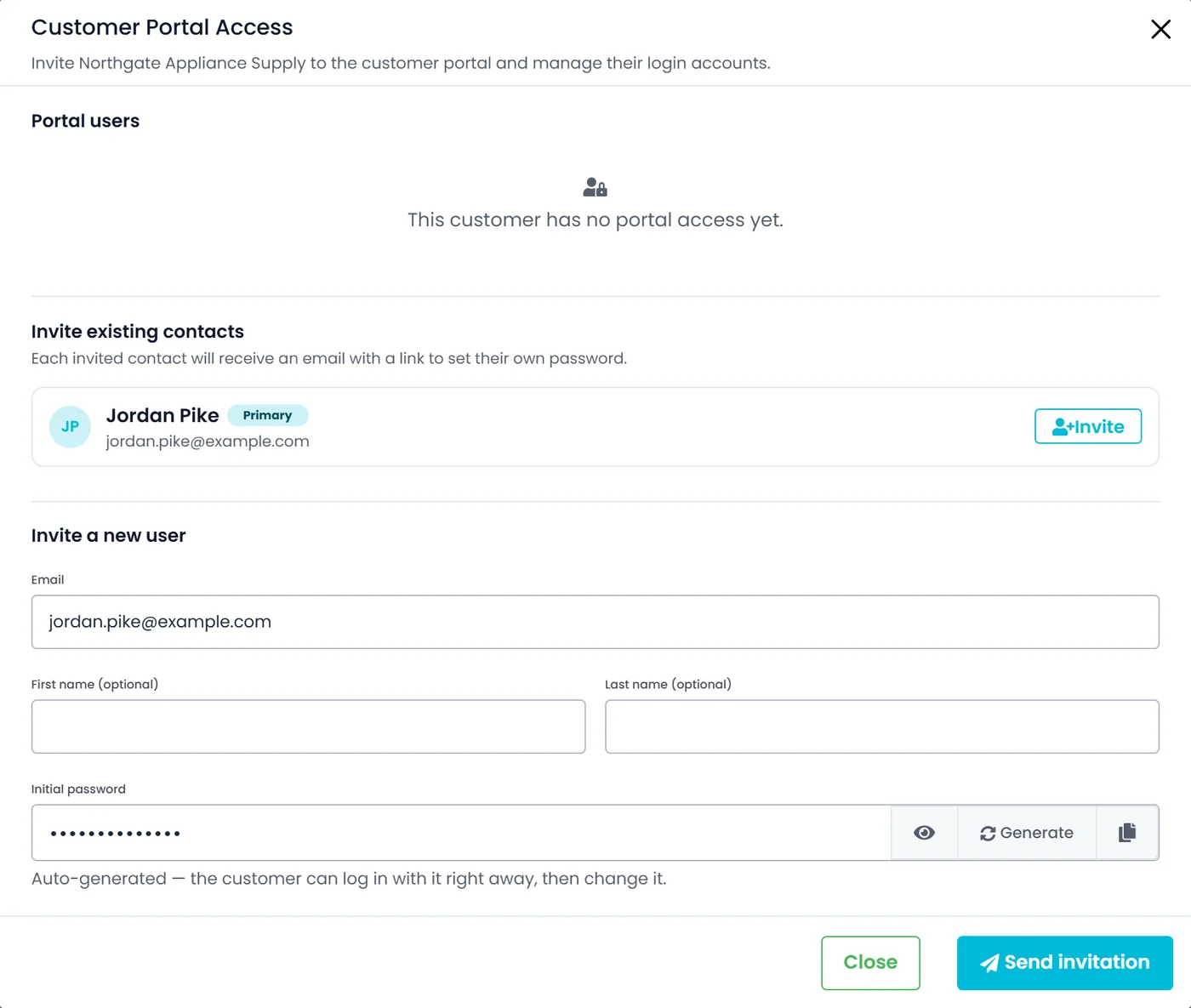
The invitation link now opens the Driver App (after installing it, if needed) with the invitation already filled in: your company's name and the name, email and phone number you saved for the driver. The driver checks the details, chooses and confirms a password, accepts the Terms of Service and the Privacy Policy, taps Activate account and is signed in. A driver who already has a RushHour account accepts the invitation with their own password. Typing the invite code by hand still works. The driver's details page now shows whether the invitation is pending, accepted, expired or cancelled, and Cancel invitation stops a pending one. In Settings → Driver App → Features, the new Invitations and sign-in card sets how long invitations keep working (by default they do not expire), whether drivers can correct the details you entered (on by default), what the app shows once a driver has joined, and whether drivers invited with a password must choose their own at the first sign-in (off by default). The invitation page in a browser now has App Store and Google Play buttons. Needs Driver App 2.0.61, which is in the stage build and not in the stores yet.
- Needs driver app 2.0.61 or later
Drivers & driver app
Drivers can sign in with their phone number and a one-time code
Drivers can now sign in to the Driver App with the phone number on their driver profile and a 6-digit code sent by text message or WhatsApp. A code works once, for 10 minutes. A code is sent only when the number matches exactly one active driver, and the app gives the same answer whether or not a number has an account. It is on by default: in Settings → Driver App → Features you can switch it off, or choose whether codes go by text message, by WhatsApp or by either. Codes by WhatsApp are sent from your own WhatsApp Business number and need a sign-in code template named on that connection in Settings → AI Agents → Channels. Text messages are switched on for your account by RushHour. Signing in with email and password always keeps working. Needs Driver App 2.0.61, which is in the stage build and not in the stores yet.
- Needs driver app 2.0.61 or later
settings
Keep a list of your trailers in Settings → Fleet
Settings → Fleet has a new Trailers button that opens a list of your company's trailers with their number, type (dry van, reefer, flatbed or other), length in feet, plate number, plate state or province, VIN and status. Adding or editing a trailer checks each field and says what to fix. A trailer number can be used only once in your company, whatever its letter case, and the VIN is saved in capital letters. A trailer you no longer use can be deactivated: it leaves the list, Show deactivated shows it again, and Activate puts it back in use. Nothing is deleted. Everyone who can view Settings → Fleet sees the list; adding, editing, deactivating and activating trailers needs the permission to change the fleet. Linking a trailer to a truck is not part of this release.
settings
One list of every truck service that is overdue or due soon
Settings → Fleet has a new Maintenance due button that shows how many truck services are overdue or due soon. It opens one list for the whole fleet: overdue services first, in red, with how many days late, then the services due within the next 7 days, soonest first. Users who can change the fleet set how many days ahead the list looks, from 1 to 365, for the whole company. Selecting a row opens that truck's Maintenance page, where the service can be marked done. The list covers your fleet trucks, inactive ones included; outside carriers' trucks are not listed. It is built from the services you plan on each truck's Maintenance page.
settings
A reminder when a truck service is due
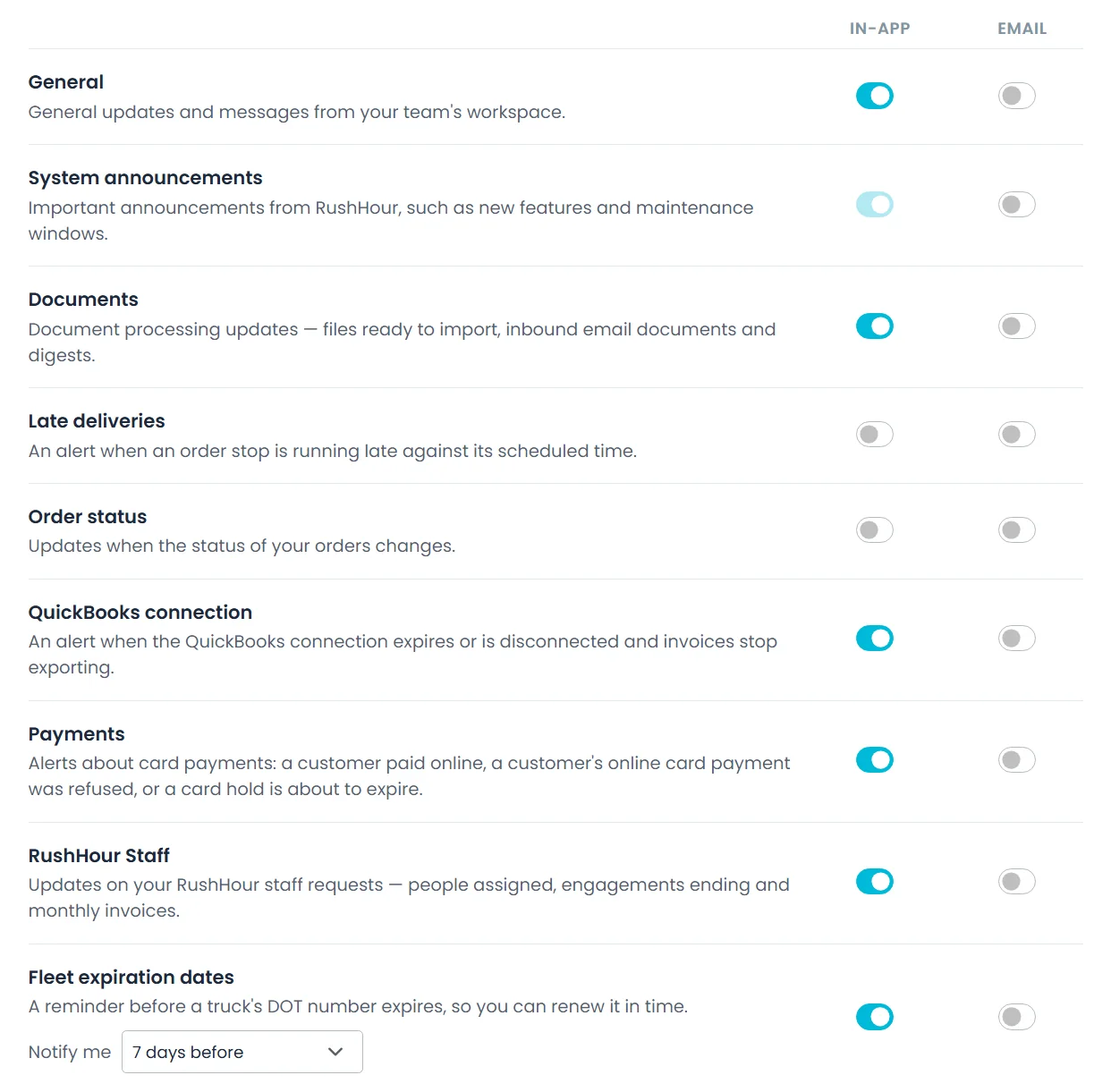
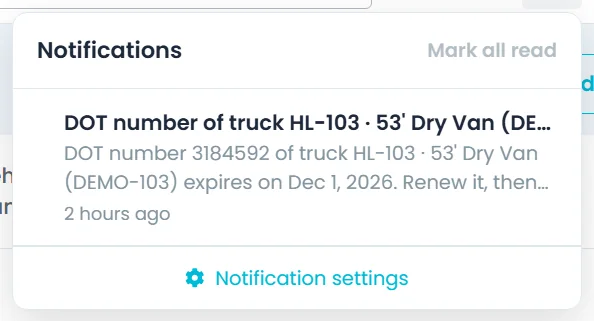
Settings → Notifications has a new Fleet service reminders row. When a service planned on a truck's Maintenance page is due within the next 7 days, the notification bell tells you once, and once more when it becomes overdue; it does not repeat every day. Marking the service done starts a new round for its next date. Selecting the reminder opens the truck's Maintenance page. The in-app reminder is on by default; email stays off until you turn it on, as on every other row. The row is offered to users who may view Settings → Fleet, and the reminders cover active fleet trucks. The 7 days are fixed and do not follow the Maintenance due window. The first time the reminders run, each service that is already overdue gets one reminder. The reminder text itself is in English for now.
Integrations & maps
Connect Geotab next to Samsara and see whether each truck's GPS is reporting
Settings → Integrations has a new Geotab row. A company admin enters the Geotab database, user name and password, can test them first (the test says how many active vehicles it found) and connects. RushHour signs in to Geotab before saving, so wrong details are refused and nothing is stored, and the saved password is never shown again. Once Geotab is connected, the truck form in Settings → Fleet has a Geotab Vehicle field next to the Samsara one (then named Samsara Vehicle), and each truck is linked to a vehicle from at least one of them. When Samsara has no vehicles to link, the note under the Samsara field says to choose the truck's Geotab vehicle instead, or, when Geotab offers none either, that the truck can be saved without one. The Fleet list then shows the GPS status, when it was last seen, the vehicle name, VIN and location for trucks linked to Geotab, as it does for Samsara; a truck linked to both uses Samsara. If Geotab cannot be read at that moment, the GPS shows as Unknown instead of an error. Disconnect asks first, and trucks keep their link. Companies that do not use Geotab see no change on the truck form or the Fleet list. RushHour only reads vehicles and their positions from Geotab.
Drivers & driver app
A switch to require a goods photo before a customer pickup is confirmed
Settings → Driver App → Features has a new Require photos on pickup switch, next to Require photos on delivery, off by default. When it is on, a driver cannot confirm a customer pickup without at least one photo of the goods, even when stop completion is not blocked. It applies only when Take a photo of goods is on in the Pickup section of the Flow tab, so drivers are never asked for a photo the app does not offer; deliveries and transfer pickups are not affected. The Driver App does not ask for the photo up front yet: until a version that does reaches the stores, a driver who skips the photo learns at the last step that it is needed and can go back and add it, so tell your drivers before you turn the switch on.
Improved5
Drivers & driver app
The text message options stay in the invite window, with the reason when texts cannot be sent
When you invite a driver and text messages cannot be sent from your account yet, the Text message and Email and text message options are now listed greyed out with the reason ("Text messages are not available yet." or "Text messages are not fully set up yet."), instead of being left out. The invite button next to the driver's phone number now opens the same choice instead of going straight to WhatsApp.
Orders & quotes
Order attachments show which driver took each photo, at which stop and when
On an order's Attachments tab, in the new and the old UI, each goods photo a driver took in the Driver App now shows whether it is a pickup or a delivery photo, the stop's address, the driver who uploaded it and when. A blind stop shows only its blind address. When an order has files from a driver, Show files lets you list All files, Driver files (everything a driver uploaded) or Other files. Office files look as before.
Platform
Price sheet import lists mileage surcharges, pallet discounts and the fuel surcharge, and flags overlapping mileage ranges
When the AI assistant imports a price sheet, its result now also says what it did with mileage surcharge bands and pallet discounts (how many were added, updated or already up to date) and which fuel surcharge it set, when the sheet has them. Before, a sheet with only those read as if nothing had changed. When a mileage range on the sheet overlaps a different range already in the pricing model (for example 0–30 mi next to 16–34 mi), the review window names each such range and what it overlaps, and starts those rows unchecked, because Settings → Pricing Models does not accept overlapping ranges. You can still tick them and import. The result text is in English.
Platform
AI imports and documents: quotes, custom prices and international rates are easier to check
In the import review window, an import that creates quotes is now called Quotes, with correct plurals ("will create 1 quote", "Import 3 rows"). When the AI set a custom price on an order, an editable Price column shows it before you import; clearing a price lets the order be priced automatically, and a negative price blocks Import. International rate cards show price breaks and surcharges as readable lines with translated headings instead of raw data, and the item type list shows names (Pallets, Boxes & Crates, Full Load, CFS, Other) instead of codes. On the Documents page, the records a document is linked to (the company's default pricing model, a customer's rate card, an order or a quote) are shown in your language. When a document cannot be attached to an order, the message now says so and what to do, instead of "An error occurred", and when an action of the assistant is refused, its card now starts with the reason. Create driver from a driver's license now also fills in the license type, expiry date, state and country on the Add Driver form.
Platform
Warehouses: a stock line's details show its stock figures, location, issues and history
Selecting a line on the Warehouses page opens its details with Quantity, Reserved and Available at the top, then its location in the warehouse, its SKU and stock level, and the customer next to the line's code. A line still in the warehouse after its planned departure is marked Overdue. A new Issues section lists units that were short, over or damaged; users who can manage warehouse inventory can report an issue (what is wrong, how many units and notes) and resolve it with how it ended. A History section shows who changed what on the line and when. Dispatch, Repack, Edit and Delete have moved to the bottom of the panel.
Fixed10
Drivers & driver app
Registering from an invitation no longer ends in "Something went wrong"
When a driver registered from an invitation and something was not accepted, for example a password the rules refuse, the driver could see only "Something went wrong", and the invitation could stop working. Now the password and the driver's details are checked before the account is created, the actual reason is passed to the app, and a failed try leaves the invitation usable, so the driver can correct it and try again. Driver App 2.0.61 shows that reason on the screen.
settings
The truck form says what is missing, and works for companies without Samsara vehicles
In Settings → Fleet, Save on the Add and Edit truck form did nothing, and said nothing, when a required field was empty. It now marks each missing field, and an Edit with nothing changed saves. Truck Type lists your Samsara vehicles, so a company with no Samsara vehicles could not add a truck, or edit one without a type. When that list is empty, Truck Type is now optional and a note under it says so. Truck Name and License Plate stay required, and when there are Samsara vehicles to choose from, Truck Type stays required as before. Date pickers throughout the Company Portal now open on the month of the date already chosen.
settings
Truck dates now show the right day in every time zone
On Fleet, the DOT Number Expiration Date and the services' Last done and Next due dates showed one day early for users west of UTC, for example in the US. Saving a truck could also store the earlier day. These dates now show and save exactly the day that was entered, in every time zone.
Platform
Warehouses → Pallets: the status filter no longer covers the pallet details, and HUB container rows fit a narrow window
On the Pallets tab of the Warehouses page, the status filter sat inside the narrow pallet list, so Assigned to container, Loaded and All statuses were drawn over the pallet details. It now has its own row above both panels and wraps on small screens. On Hubs → Containers in a narrow window, a pallet's details no longer run under its Scan in and Remove buttons: the rows wrap, and the page stacks its columns when there is not enough room. In Hebrew, names that end with punctuation, such as "Supply Co.", are now shown correctly on both screens.
Platform
Warehouses: a pallet that left in a container no longer takes the stock of a pallet still in the warehouse
When one order item is split over two pallets and one of them leaves in a container, dispatching the pallet that left now takes only the stock that the pallets still in the warehouse do not need. Before, it could take the other pallet's units. The Inventory tab then showed none of the item in stock, and the pallet still in the building read as dispatched and could not be dispatched itself. A pallet that is in the warehouse dispatches as before.
Orders & quotes
Classic order screen: an item stepped down to 0 and back up stays on the order
In the classic order screen, clicking − on an item until it reached 0 and then + showed the number again on the card, but after saving the item was gone from the order. Now stepping back up keeps the item, and on a pickup its deliveries come back with their amounts, up to what the pickup now carries. An item left at 0 is still removed, as before.
Orders & quotes
Confirm & Create Delivery on Order details confirms the stop, and the buttons work again after saving
On the Order details page, after Confirm & Create Delivery and adding the new delivery, the delivery you were confirming could stay unconfirmed when saving the order took a long time, and the confirmation window came back with every button disabled and nothing on screen. Now the order is saved first and the stop is confirmed after it. In both confirmation windows, in the new and the old UI, the button you clicked shows a spinner while it saves, and if something fails the message is shown and the buttons work again.
Orders & quotes
Orders: the Invoice Actions window shows its options again
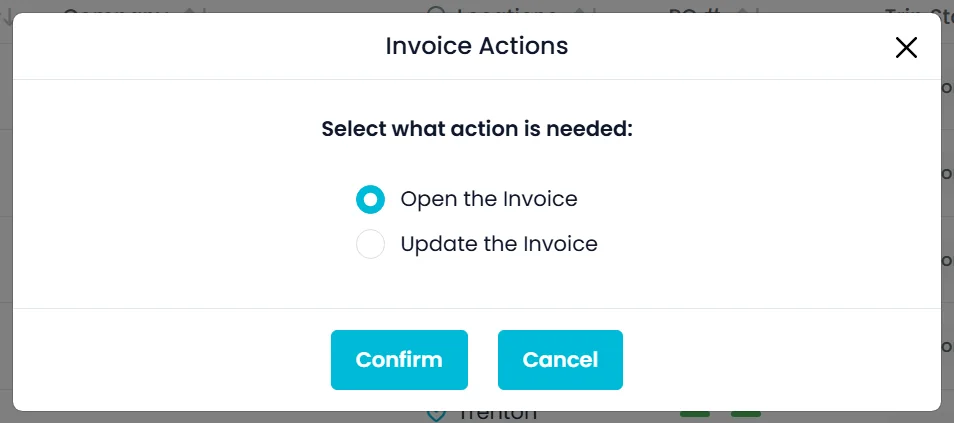
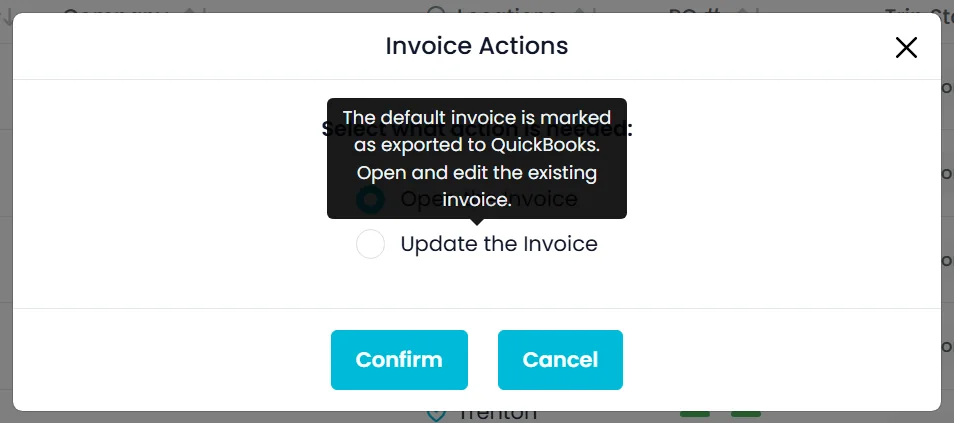
In the new look, the invoice icon on an Orders list row opened the Invoice Actions window without any options. It now offers them again, as the classic look does: Create Invoice when the order has no invoice (and Close & Create Invoice when the order is assigned or in transit and not closed yet), and Open the Invoice or Update the Invoice when it has one. Before the options disappeared, they showed as text that could not be selected, so Confirm always ran the first one; now each can be chosen. When Update the Invoice is not available, it is greyed out and its tooltip says why. The window is also in Hebrew now, in both looks.
Billing & accounting
Accounting: the invoice list shows the right rows after a search is cleared or the customer changes
In Accounting → Invoices in the classic look, after choosing All, a search in the customer list or a change of page loaded new rows but did not show them. In the new look, clearing the page search with a customer selected now lists that customer's invoices again. In both, clearing the search on All goes back to page 1 and clears the ticked rows, a slow answer no longer brings back a customer you had already moved away from, and a link or bookmark to a customer that no longer exists opens on the first customer instead of an empty list. Accounting still opens on the first customer, as before.
Compliance & safety
IFTA report: the “IFTA is off” notice points to the right place
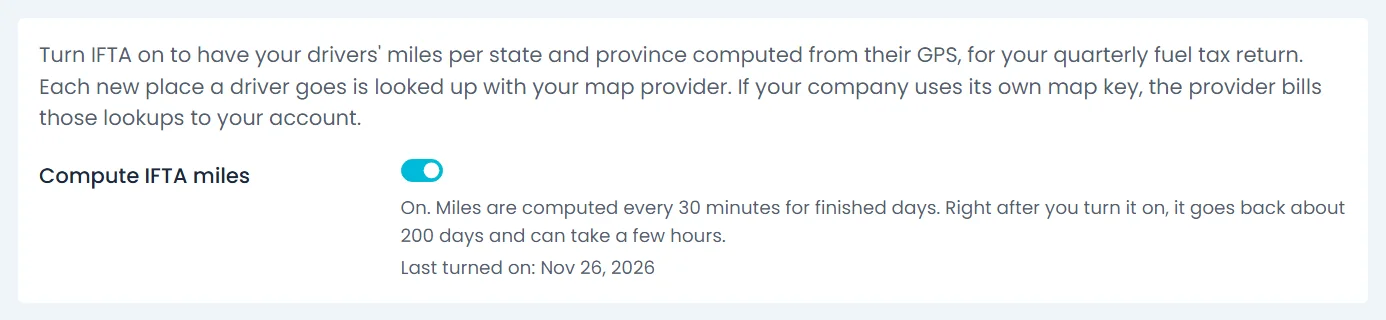
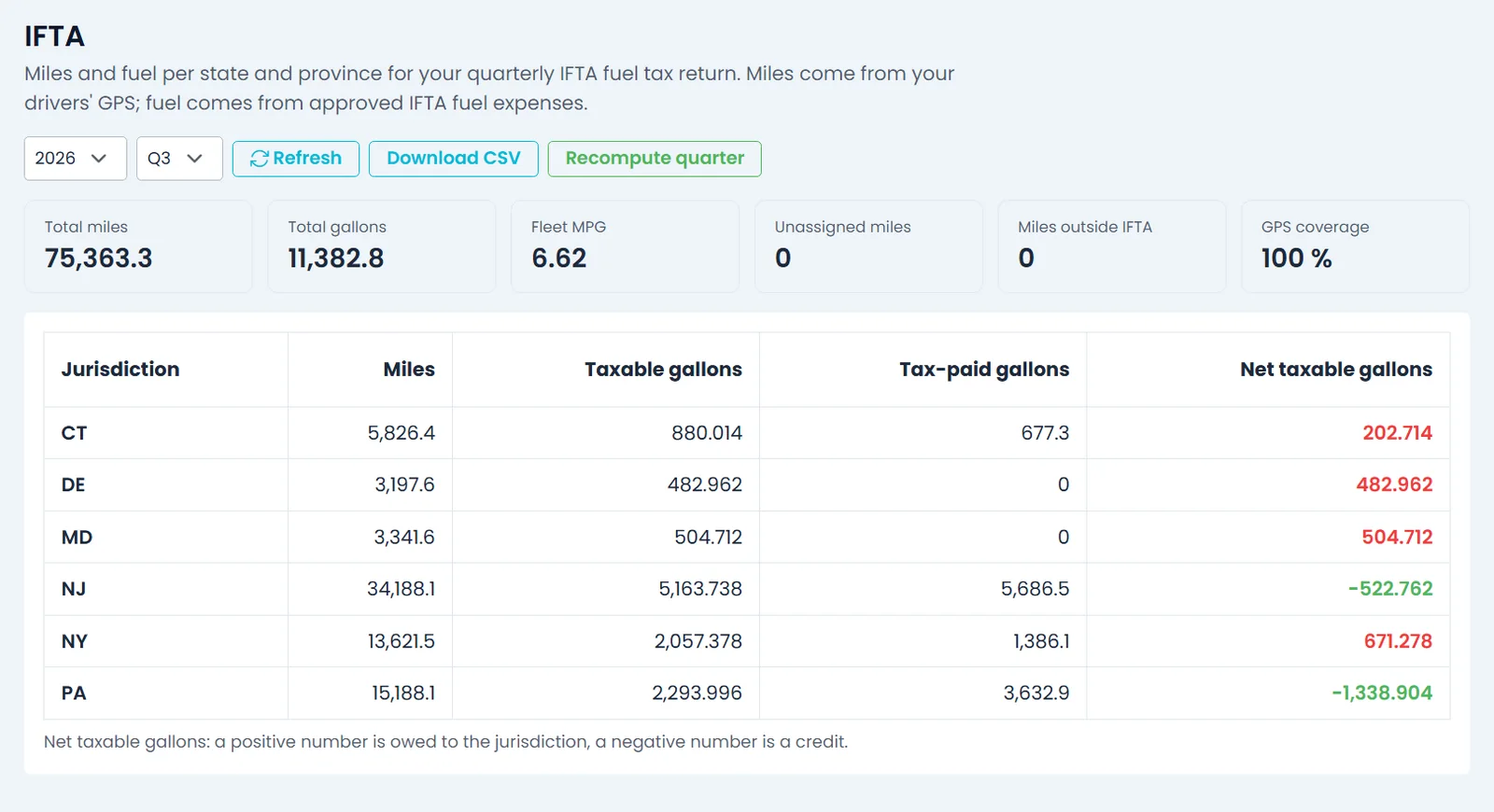
When IFTA is off, the notice on the IFTA report now says to turn it on in Accounting → Expenses → Setup → IFTA. It used to name Settings, where Expenses is no longer listed. The button under the notice already opened the right page.